
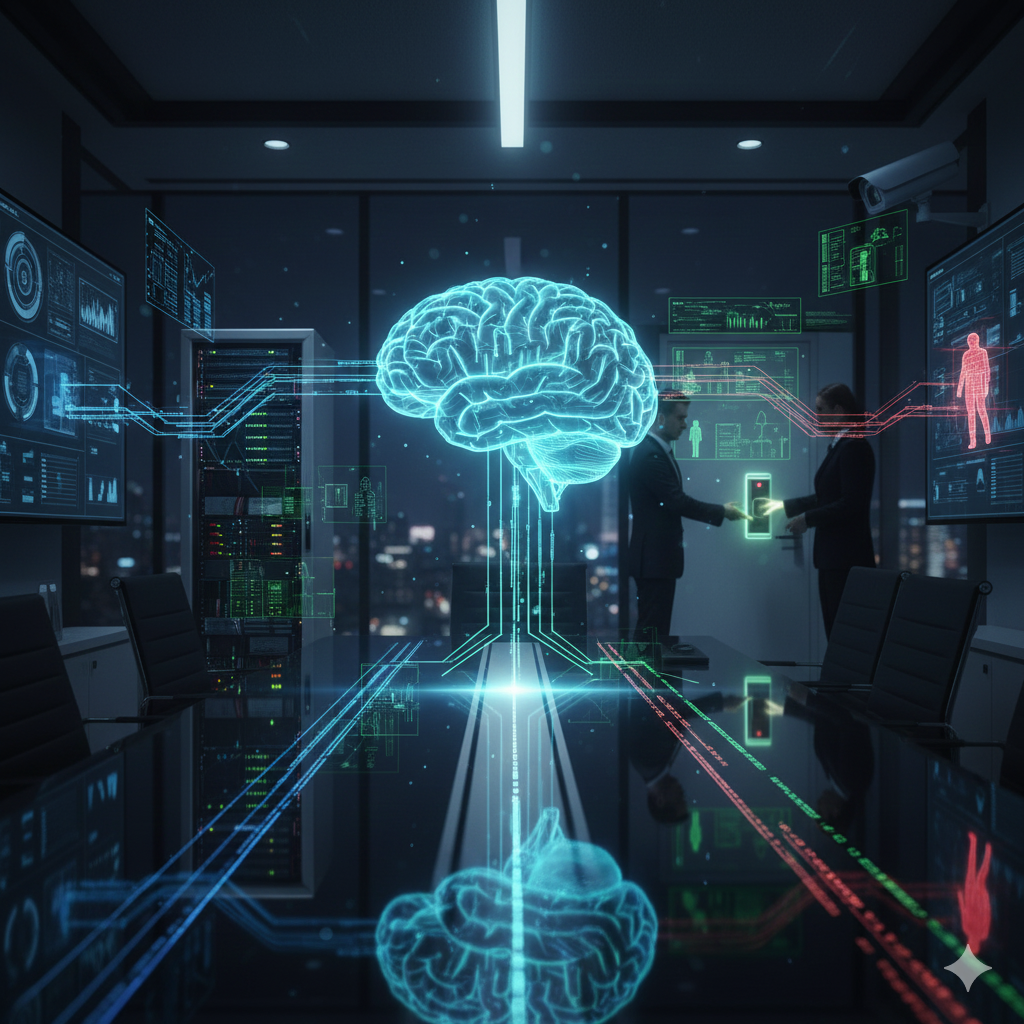
For years, security has been a fundamentally reactive discipline. An alarm goes off. A motion sensor triggers. A breach occurs. Only then do you react. While this system has served us well, the pace of modern business and the increasing sophistication of threats demand something more intelligent.
The time has come to shift from simply responding to incidents to actively anticipating them. This is the promise of AI Driven Predictive Security, and it is changing the game for physical security, access control, and network management.
From Data Streams to Foresight: How Machine Learning Works
The core idea behind predictive security is straightforward: your security infrastructure is generating a massive amount of data, and machine learning can turn that raw data into actionable foresight.
Think of every swipe of an access card, every minute of video footage, and every packet of network traffic as a data point. When a human monitors these things, we rely on specific rules or visual confirmation. But when an AI analyzes this entire, unified stream, it’s looking for something much deeper: patterns and anomalies.
Machine learning models are trained on months or even years of historical “normal” behavior. Once the model understands normal, anything that deviates—even slightly—gets flagged not as an alert, but as a prediction of a future problem.
This integration across multiple security components is key:
-
Access Control Data: Not just who swiped when, but a pattern of access. For example, a user who consistently accesses a storage room at 9:00 AM suddenly attempts access at 2:00 AM from a new location. That’s an anomaly.
-
Video Surveillance Data: AI identifies normal routes, common object placement, and typical crowd density. A subtle change, like an object left in an unusual spot or a person entering a restricted area at an irregular speed, becomes a precursor to an incident.
-
Network Data: This includes the health of your devices. The AI tracks temperature, bandwidth use, and processing load of your cameras and servers.
When these data points converge, the system moves past a simple “motion detected” alert to a powerful “high risk behavior predicted” warning.
Predicting the Unforeseen: Two Key Applications
The true power of AI driven security lies in its ability to prevent two fundamentally different kinds of threats: equipment failure and behavioral risk.
1. Anticipating Equipment Failure
Security is only as good as the hardware running it. If a hard drive fails on your video recorder, you lose critical footage. If an access panel overheats, a crucial entry point becomes vulnerable.
Predictive security uses the network data to spot these technical threats before they manifest. The machine learning model sees that a particular camera’s temperature has increased by three degrees over the past four days, or that a server’s disk latency is slowing down well below its historical average.
Instead of waiting for the camera to fail or the server to crash, the system generates a ticket: “Access Panel 3 is predicted to fail within 48 hours due to escalating temperature anomaly.” This allows your maintenance team to perform a proactive replacement or repair during downtime, eliminating a massive vulnerability.
2. Detecting Behavioral Anomalies
This is where the shift from reactive to predictive is most impactful. AI analyzes hundreds of variables related to human movement and access to identify potential internal or external threats.
The system is constantly looking for:
-
Credential Misuse: An employee who has never used their badge on a weekend suddenly attempts access repeatedly.
-
Tailgating Probability: Not just detecting tailgating after it happens, but flagging a pattern of door propping or lingering that suggests a potential compromise point.
-
Irregular Movement: A person who has successfully accessed a building suddenly appears lost or is observed covering a camera lens.
By correlating an unusual access attempt with an unexpected movement in a video feed and an irregular login pattern on the internal network, the AI establishes a high probability of a threat and gives security teams vital minutes to intercept or verify the situation before a loss of property or data occurs.
The Future is Proactive, Not Passive
The era of merely setting a perimeter and waiting for a rule violation is ending. AI driven predictive security moves your organization out of a defensive posture and into a proactive one. It allows you to use your existing security technology—your access readers, your cameras, your network infrastructure—as intelligent sensors that work together to see into the future.
This means fewer false alarms, a vastly lower risk of critical system failure, and, most importantly, the ability to neutralize threats before they ever become incidents.
Is your security system ready to start predicting the future?